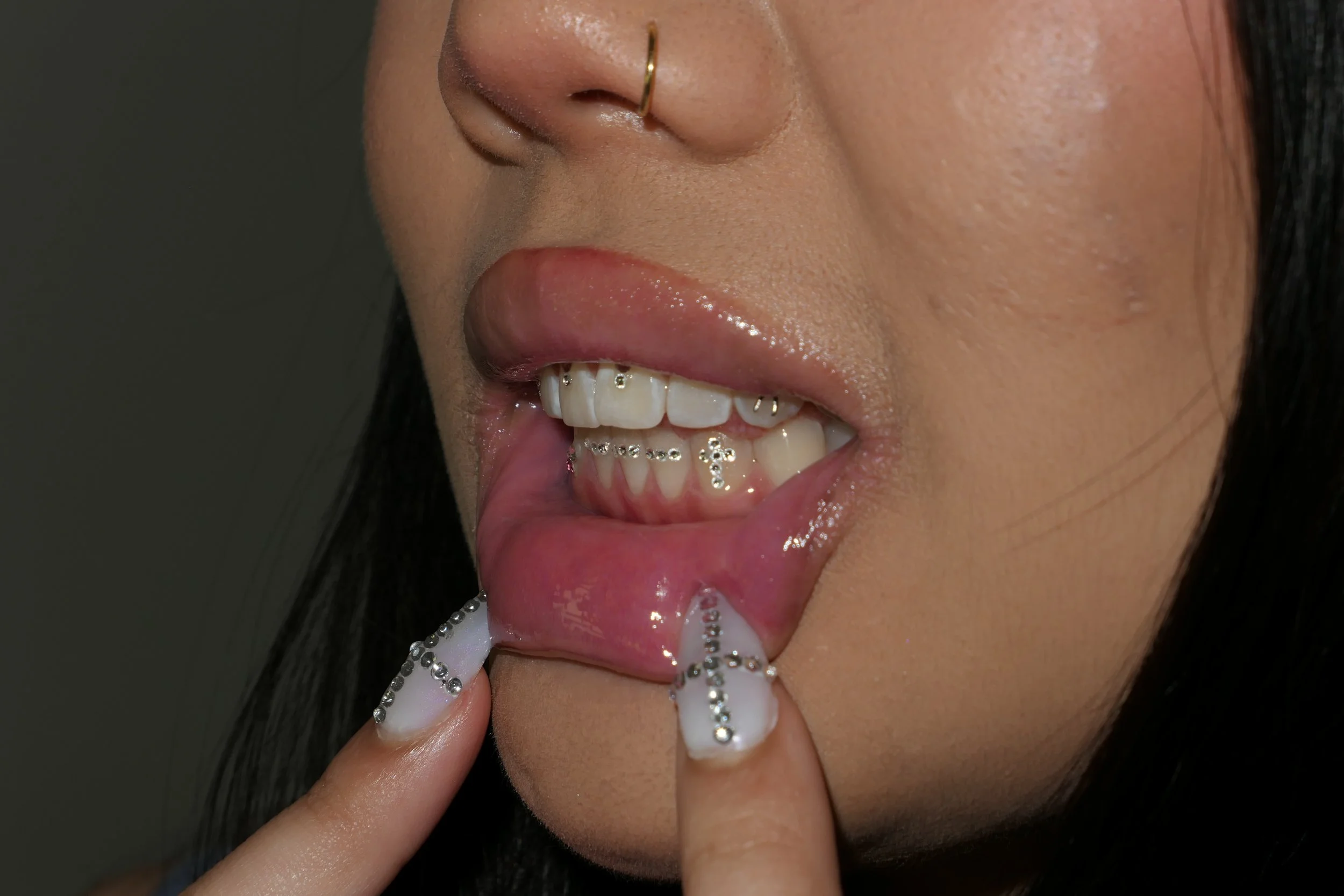

Most tooth gem technicians can follow a bonding protocol. Far fewer understand why it works.
Dental adhesive chemistry is the foundation of gem retention. If you don't understand what's happening at the molecular level when you etch, prime, bond, and cure, you're following a recipe without knowing why the ingredients matter. That ignorance shows up as premature gem failure, inconsistent retention, and clients who leave reviews questioning your competence.
This article breaks down the chemistry behind dental bonding systems — not so you can impress clients with jargon, but so you can troubleshoot failures, select appropriate materials, and understand why environmental factors like humidity and temperature affect your results.
The Four-Stage Bonding Process: Etch, Prime, Bond, Cure
Modern dental adhesion relies on a multi-step chemical process that transforms smooth enamel into a surface capable of mechanical interlocking and chemical bonding with resin-based materials.
Stage 1: Etching with Phosphoric Acid
Enamel is 96% hydroxyapatite — a crystalline calcium phosphate mineral. In its natural state, enamel is too smooth and non-porous for adhesive penetration. Etching with 35–37% phosphoric acid dissolves the interprismatic enamel, creating microscopic pores and increasing surface area by approximately 2000%.
The chemical reaction is a controlled demineralisation: phosphoric acid donates hydrogen ions (H⁺) that react with hydroxyapatite, breaking down the calcium phosphate crystal lattice and creating a roughened, porous surface approximately 5–50 micrometres deep.
Etching time is critical. Under-etching (less than 15 seconds) produces insufficient porosity. Over-etching (beyond 60 seconds) doesn't increase porosity but does risk desiccating the enamel, which compromises subsequent adhesive infiltration.
Stage 2: Priming — The Hydrophilic-Hydrophobic Bridge
After etching and rinsing, enamel is hydrophilic (water-attracting) due to residual moisture in the micropores. Dental adhesives and composites, however, are hydrophobic (water-repelling) resin systems. Without a primer, the resin cannot penetrate the moist enamel pores effectively.
Primers contain amphiphilic molecules — compounds with both hydrophilic and hydrophobic functional groups. The most common primer molecule is HEMA (2-hydroxyethyl methacrylate), which has a hydrophilic hydroxyl group that bonds to water molecules in the enamel pores and a hydrophobic methacrylate group that bonds to the resin in the bonding agent.
The primer infiltrates the etched enamel, displacing water and preparing the surface for resin penetration. This stage is often skipped or rushed by untrained technicians, leading to weak bonding and early gem detachment.
Stage 3: Bonding Agent Application
The bonding agent is a low-viscosity resin — typically bis-GMA (bisphenol A-glycidyl methacrylate) or UDMA (urethane dimethacrylate) — that flows into the primed enamel pores and polymerises to form resin tags. These tags create mechanical interlocking between the enamel and the composite used to attach the gem.
Bonding agents also contain photoinitiators (usually camphorquinone) that remain inert until exposed to blue light in the 450–490nm wavelength range. This allows working time for precise application before polymerisation is triggered.
Stage 4: Light Curing — Photoinitiator-Catalysed Polymerisation
When the bonding agent is exposed to a dental curing light, camphorquinone absorbs photons and enters an excited state. It then reacts with a co-initiator (typically an amine) to generate free radicals — highly reactive molecules that initiate a chain reaction of monomer-to-polymer conversion.
The methacrylate groups in the resin molecules form covalent bonds with each other, creating a cross-linked polymer network within 20–40 seconds. This hardened resin is what anchors the gem to the tooth.
Inadequate curing — caused by insufficient light intensity, incorrect wavelength, or insufficient exposure time — results in incomplete polymerisation. The bonding layer remains soft, weak, and prone to failure.
BIS-GMA Resin Chemistry: Why It Matters
Bis-GMA is the workhorse resin in most dental adhesives and composites. Understanding its properties explains why certain application techniques work and others fail.
Bis-GMA is a large, rigid molecule with high viscosity. This gives it excellent mechanical strength once polymerised, but it also means it doesn't flow easily into enamel pores. That's why it's diluted with lower-viscosity monomers like TEGDMA (triethylene glycol dimethacrylate) in bonding agents.
Bis-GMA also has hydrophobic aromatic rings, which is why moisture contamination during bonding is catastrophic. If saliva or water contacts the bonding agent before curing, it disrupts polymerisation and creates voids in the adhesive layer.
"The difference between a gem that lasts two weeks and one that lasts two years often comes down to moisture control during the bonding phase. Chemistry doesn't forgive sloppy technique."
Why Curing Light Specifications Matter
Not all curing lights are equal, and using an underpowered or incorrect-wavelength light is one of the most common technical failures in tooth gem application.
Camphorquinone — the photoinitiator in most dental bonding systems — has peak absorption at 468nm (blue light). Curing lights must emit in the 450–490nm range with sufficient intensity to activate polymerisation.
Light Intensity (mW/cm²): Minimum 800 mW/cm² is required for adequate curing. Professional dental curing lights output 1000–2000 mW/cm². Cheap LED lights marketed for nail gel curing often emit at 365nm (UV-A range), which doesn't activate camphorquinone and results in uncured resin.
Exposure Time: At 1000 mW/cm², 20 seconds is typically sufficient. Lower-intensity lights require longer exposure — 40 seconds at 600 mW/cm². Under-curing leaves unreacted monomers that leach out over time, weakening the bond.
Light Guide Distance and Angle: The light guide must be positioned within 2mm of the bonding surface and perpendicular to maximise photon delivery. Angled or distant positioning reduces effective intensity and creates incomplete polymerisation zones.
Using a curing light without verifying its specifications is guesswork. If you can't confirm your light's output wavelength and intensity, you're gambling with every gem you apply.
Master the chemistry behind bonding protocols. The Booked & Bonded Masterclass covers adhesive systems, material selection, curing light specifications, and troubleshooting retention failures with a clinical, evidence-based approach.
Explore ProgramsComposite Cement Chemistry for Gem Attachment
The final material in the bonding stack is the composite cement that holds the gem to the primed and bonded enamel. This is typically a flowable resin composite — a mixture of resin matrix (bis-GMA, UDMA) and inorganic filler particles (silica, zirconia, or barium glass).
The filler particles serve multiple functions: they increase mechanical strength, reduce polymerisation shrinkage, and improve wear resistance. Filler loading (percentage by weight) typically ranges from 60–80% in flowable composites.
Polymerisation Shrinkage: When resin monomers polymerise, they form covalent bonds and pack more densely, causing the material to shrink by 2–6% by volume. This shrinkage generates stress at the enamel-composite interface. If the bond isn't strong enough to resist this stress, the gem debonds immediately or develops microgaps that weaken over time.
This is why incremental curing (applying composite in thin layers and curing each layer separately) is recommended in restorative dentistry. For tooth gems, the composite layer is thin enough (~0.5mm) that single-step curing is acceptable, but the bonding agent must be flawless to resist shrinkage stress.
Temperature and Humidity Effects on Bonding
Dental adhesive chemistry is temperature- and humidity-sensitive. Environmental conditions in your workspace directly affect polymerisation kinetics and bond strength.
Temperature: Resin viscosity decreases as temperature increases. Working in a warm room (above 25°C) makes adhesives and composites flow more easily, improving penetration into enamel pores. However, excessive heat (above 35°C) can cause premature polymerisation before light curing, reducing working time.
Cold temperatures (below 18°C) increase viscosity and slow polymerisation, requiring longer curing times. Store adhesive materials at room temperature (20–25°C) and allow refrigerated materials to warm before use.
Humidity: High humidity increases the risk of moisture contamination during bonding. Water molecules compete with resin monomers for space in etched enamel pores and disrupt polymerisation. Ideal relative humidity is 40–60%.
In humid climates or poorly controlled environments, extend isolation time (using cotton rolls or dental dam) and verify enamel is completely dry before applying primer. A quick air blast test — if the etched enamel appears chalky white and matte, it's dry; if glossy, it's still wet — is essential.
Common Adhesive Systems Used in Tooth Gems vs. Restorative Dentistry
Tooth gem bonding typically uses simplified adhesive systems compared to multi-step restorative protocols, but the chemistry is fundamentally the same.
Total-Etch Systems (3-Step): Separate etch, prime, and bond steps. This is the gold standard in restorative dentistry and offers the highest bond strength. Examples: Adper Single Bond (3M), OptiBond FL (Kerr).
Self-Etch Systems (2-Step): Combine etch and prime into one acidic primer that simultaneously demineralises enamel and infiltrates. Faster application but slightly lower bond strength on enamel. Examples: Clearfil SE Bond (Kuraray), AdheSE (Ivoclar).
Universal Adhesives (1-Step): Combine etch, prime, and bond into a single bottle. Convenient but generally weaker bonds than multi-step systems. Examples: Scotchbond Universal (3M), Prime&Bond Elect (Dentsply).
For tooth gems, total-etch systems are preferred because enamel bonding (as opposed to dentine bonding) benefits from aggressive phosphoric acid etching, which self-etch primers don't provide as effectively.
Many untrained technicians use nail adhesives or craft glues for tooth gem application. These are cyanoacrylate-based adhesives that polymerise via moisture (not light), have no enamel-specific chemistry, and fail rapidly under oral conditions. Using non-dental adhesives is a hallmark of inadequate training and a liability risk.
Why Chemistry Knowledge Translates to Better Outcomes
Understanding adhesive chemistry isn't academic — it's practical troubleshooting power.
When a gem fails within 48 hours, you can trace the failure back to a specific chemical breakdown: inadequate etching (insufficient porosity), moisture contamination (disrupted polymerisation), under-curing (incomplete polymer cross-linking), or incorrect material selection (incompatible resin systems).
Technicians who understand chemistry adjust their technique based on environmental conditions, recognise when a material has degraded or been stored incorrectly, and select bonding systems appropriate for the clinical scenario.
Technicians who don't understand chemistry follow protocols blindly and have no framework for troubleshooting when those protocols fail.
The most common bonding mistakes — skipping primer, inadequate curing, moisture contamination — are all chemistry failures, not technique failures. Fixing them requires understanding why each step exists and what happens when it's compromised.
Where Tooth Gem Chemistry Training Fails
Most tooth gem courses teach the steps — etch, rinse, dry, prime, bond, cure, attach gem — without explaining the chemistry. Students leave with a checklist but no understanding of why the sequence matters or how to adapt when conditions aren't ideal.
This creates technicians who can apply gems in controlled conditions but fail when humidity is high, when their curing light battery is low, when they're working on enamel with existing restorations, or when a client has fluorosis that affects etch patterns.
Training programs led by dental professionals — who studied adhesive chemistry as part of their clinical education — provide the theoretical foundation that transforms checklist-followers into competent clinicians.
The Booked & Bonded Masterclass, developed by a registered oral health therapist with a Bachelor of Oral Health from the University of Sydney, includes detailed breakdowns of adhesive chemistry, material selection, troubleshooting retention failures, and how environmental factors affect bonding outcomes. It's designed for technicians who want to understand the science, not just memorise the steps.
If you're serious about building a professional tooth gem business with consistent results and long-term client satisfaction, chemistry knowledge isn't optional. It's the difference between a technician and a professional.
For more on the substrate you're bonding to, read The Science of Enamel. For client assessment before you ever open an adhesive kit, see How to Screen Clients for Tooth Gem Candidacy.
The chemistry is what makes gems stay. Learn it properly.